

Mason Bee Cocoons - Blue Orchard
Mason Bee Cocoons - Blue Orchard
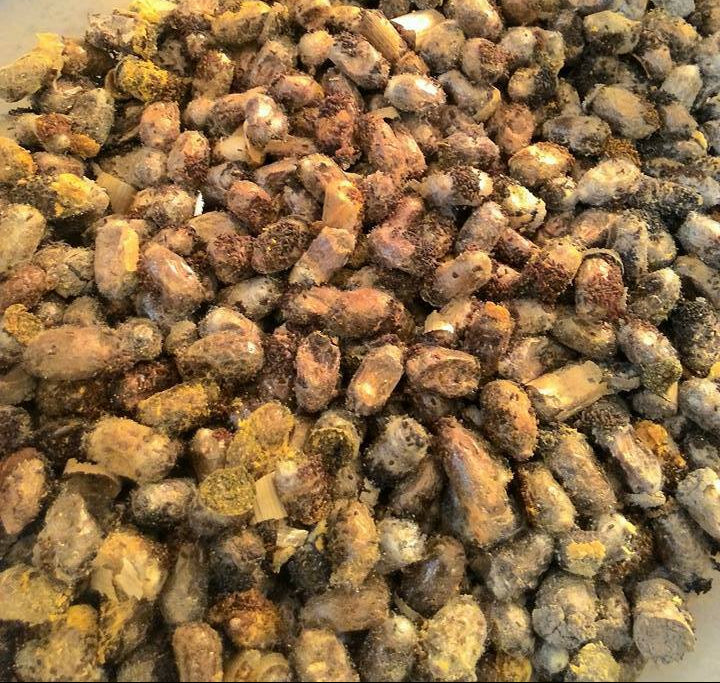
Amazing spring pollinators. One bee does the work of 20 honeybees. These are inspected and cleaned cocoons.
I prefer to ship orders with cocoons on MONDAYS or TUESDAYS. I do not ship them with a cold pack. You can refrigerate upon receipt or anytime after early February is a good time to place outside and let mother nature tell them when to wake up.
Blue Orchard Mason Bees - Osmia lignaria
Native Blue Orchard Mason Bees emerge when temperatures reach a solid 55 degrees. This is usually when your fruit trees are starting to bloom. They are a NATIVE Solitary bee that bee for bee, pollinate at least twenty times better than honeybees. They don't travel as far, they will stay right in your yard and are wonderful at pollinating your fruit trees or orchard. The males are incapable of stinging, and the females sting SO rarely that they are considered "stingless" and even if you do get stung, the venom is not like that of a honeybee and is more like a mosquito bite. They do not produce honey and love living near other bees so there is no reason for them to be aggressive. They gather nectar and pollen to pack in with their young. They would love access to a mud source such as a little pot with mud so they can make the dividing cells between their young. Hence the name "Mason" bees. The Orchard is for the fact that they pollinate your fruit trees wonderfully. You can have the perfect pruned tree and space, but without pollination, no fruit.
These beauties are stunning in the garden. They’re a beautiful deep black and shiny blue. They are NOT aggressive and if you are stung, you’ll practically have to force them to sting you and it’s more if a mosquito bite type sting. They do very well alongside your honeybee. They follow a very similar life cycle to leaf cutter bees. The females are laid near the back, the males emerge first and eagerly wait until the females emerge. They mate, the males die off (sorry boys!) and the females go to work collecting pollen which their lay their eggs on and then gather mud to seal off the individual cells in between. Blue mason bees usually start emerging around the time your apricot trees blossom. These guys are the best at pollinating your spring fruit trees. They hatch and forage for 6-8 weeks when go into hibernation until the following spring.
WHEN THEY ARRIVE
When you receive your package of Blue Orchard Mason Bees bees, immediately put bees in a fridge. They will be in a pop-top black pill-bottle style tube. Even a few hours at higher temps can tell them it's time to wake up. If they DO wake up early or in shipping, they will be JUST FINE. Place some karo syrup on a q tip, cut the tip off and put it in the tube for them to feed in in your fridge until your desired release date. Sometimes they can get a little dry as well. I will squeeze out a damp piece of paper towel the size of a quarter and place it in their tube. this gives them some humidity without it being wet. But know that the cocoons are waterproof.
This truly is one of my favorite parts of my garden. These tiny tiny native bees are so fun and I have personally seen the benefits of their pollination.
More info:
Habitats-Our locally sourced reeds are a favorite habitat for Native bees. NEVER USE DRILLED BLOCKS OF WOOD THAT CANNOT COME APART. Do not use BAMBOO reeds, plastic straws or anything that can not be inspected.
--Boards-(laminate)These re-usable and long lasting alder wood boards allow you to quickly and easily inspect your hive in the winter. seal it back up and you're done. They have had bees in them previously which is the best attractant. I have opened them up, cleaned out any bad bugs, made sure they are clean and ready for your yard. We sell these in a tube of 20 (or more!) bees, males and females. When they are ready to emerge they easily hatch and look for a place to nest, pollinate and mate. If you need more than 20 bees, we sell them at a ration of 8 females to 12 males. You can buy additional bees from us. We have limited stock and bees usually need to be put out by the end of April. These guys need to be kept cool and dormant until it is time. Put them in your refrigerator when you get them. The males emerge first and females next anywhere from one-three days, to three to four weeks after the males emerge. Bees may emerge even at low 35-40 degrees in your fridge. This is due to them running out of stored fats and they must emerge to feed. You can give them a little Karo syrup on a cotton ball to feed them if it's not time yet. When putting bees out watch for an average daytime temp in the low to mid 50°F (or warmer) AND the presence of OPEN blossoms in your yard or orchard. Our Pine Box (in a separate listing) is specifically made to easily house your habitat for Mason Bees bees and last a very long time. Pre-painted white, it is ready to mount or decorate first. It works perfectly to put your habitat boards in and mount on a fence, post, garage, tree or stuff it in a bush in full to part sun, south or east facing is best but not necessary. Eye level is best not just for them but because it's fun to watch them. South or East facing is best. I can't tell you how great for kids this is. It's an activity that they can accomplish that they can also take ownership in. These bees are not aggressive. It's the perfect pet because there is not really any maintenance. (okay, once, for about 15 minutes in winter) These will help keep predatory bugs from taking over your habitat by creating a good solid healthy colony.
This would make an amazing gift to any gardener. Mothers Day? Yes, way better than flowers.
PLEASE NOTE:
I do not guarantee bees. I do not accept returns, exchanges, or refunds on bees. I will do my absolute best to give you an amazing and successful experience and note that as much as I am trying to be a sincere advocate to help the bees, mother nature still has a say. Please feel free to reach out with any questions, I'm here to help.
Share